There are photographs of the First World War that show generals, ruined towns, artillery pieces and great moments of history.
And then there are photographs like this.
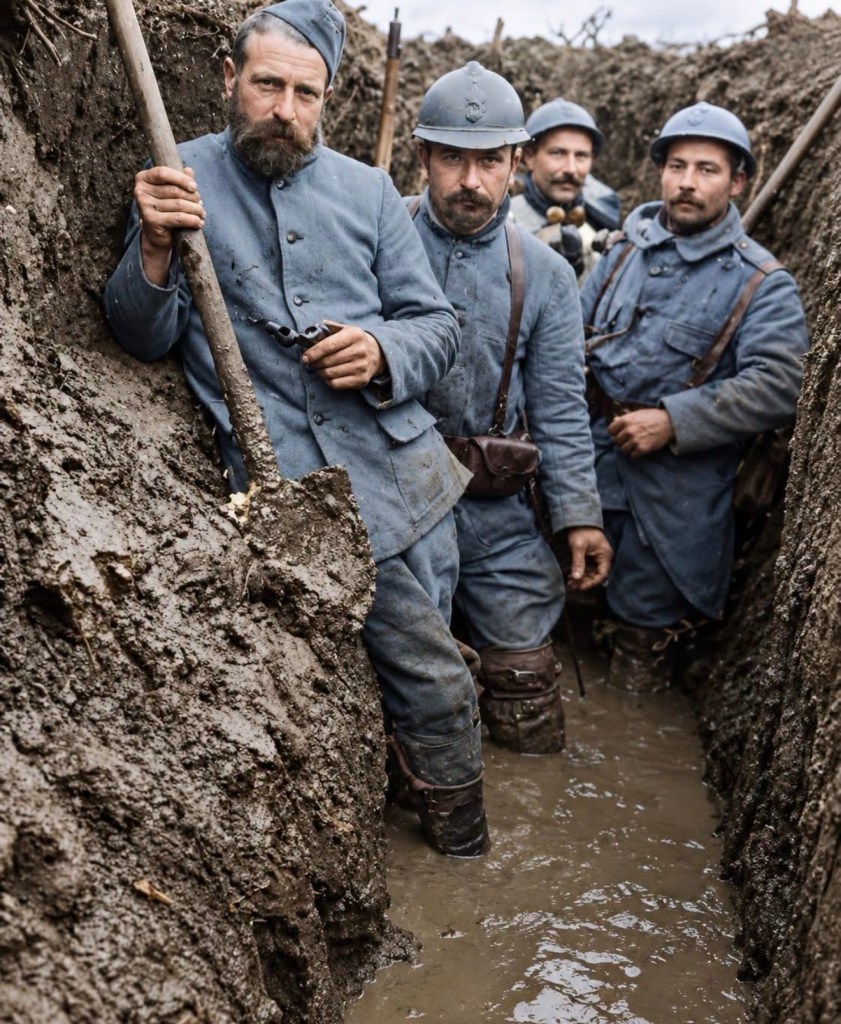
Four French soldiers stand in a trench filled with brown water. The mud has climbed the walls, collected around their boots and turned the narrow passage into something closer to a ditch or stream. One man holds a shovel. Another looks directly towards the camera. Behind them are rifles, equipment, earth and the endlessly repeated practical work of keeping a trench usable.
There is no dramatic attack taking place.
That may be exactly why the photograph is so powerful.
By 1915 the Western Front had settled into a vast network of trenches stretching from the North Sea towards Switzerland. The great movements of the opening months of the war had given way, in many sectors, to something very different: men living for days at a time below ground level, surrounded by earth, water and timber.
Rain could transform these positions remarkably quickly.
Water gathered in the bottom of trenches. Walls collapsed. Duckboards shifted or disappeared beneath the mud. Dugouts required repair. Drainage channels had to be cleared and new trenches continually dug, strengthened and maintained.
All of this continued while the men remained within range of artillery, snipers and raids.
The enemy was not always standing on the other side of No Man’s Land.
Sometimes the enemy was simply water.
Wet clothing, cold feet, lice, rats, exhaustion and infection became part of trench warfare. The physical strain was accompanied by the psychological effect of living in cramped, uncomfortable surroundings where danger might arrive suddenly and without warning.
The French infantryman increasingly became known by one enduring name:
the poilu.
The word is often explained literally as “hairy one”, giving rise to the image of the unshaven, moustachioed soldier emerging from the trenches.
But the expression was older than the First World War. It already carried ideas of toughness, courage and masculine endurance. During 1914–18 it became inseparable from the ordinary French soldier himself.
The men in this photograph also illustrate another transformation taking place within the French Army.
The conspicuous uniforms of 1914 were being replaced by horizon blue, while the distinctive Adrian helmet began appearing during 1915. The helmet was never intended to make its wearer invulnerable to bullets. Its principal purpose was protection from shell fragments and debris falling from above.
It became one of the defining images of the French soldier of the Great War.
Yet perhaps the most interesting thing about this photograph is what we do not know.
The men appear to be anonymous.
No familiar names. No celebrated officers. No heroic caption describing an important battlefield achievement.
Just four soldiers standing in water.
And behind them were millions of others whose war consisted not only of attacks and bombardments, but of carrying, repairing, digging, waiting, eating, sleeping and attempting to remain dry in landscapes that sometimes seemed determined to swallow them.
That is worth remembering when we encounter a single military record.
A name such as Claude Gressard, for example, can eventually lead us towards a regiment, a family, a village and the place where a life ended. But military paperwork rarely describes the enormous amount of ordinary existence that occurred between those recorded moments.
Claude served later in the war, but the world shown in this photograph remained part of the world of the French infantryman: earthworks, equipment, weather, fatigue and innumerable practical tasks undertaken far from the great narratives written afterwards.
History often records the battle.
Photographs such as this remind us of the living that had to be done between the battles.
And sometimes that meant standing knee-deep in mud with a shovel.

