A Spaniard, a Swiss hotelkeeper, and the question of becoming British
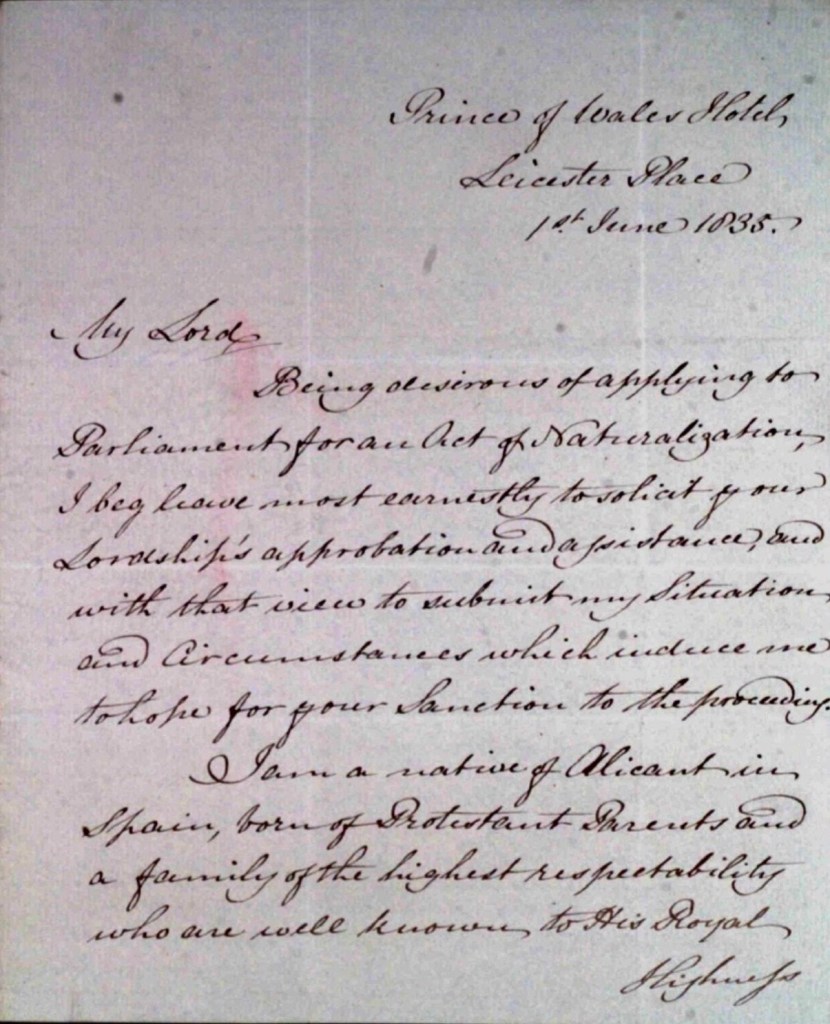
On 1 June 1835, a man sitting in the Prince of Wales Hotel in Leicester Place, just off Leicester Square, began a letter.
“My Lord,
Being desirous of applying to Parliament for an Act of Naturalization…”
His name was Baron de Arabet.
He had been born in Alicante in Spain, but according to the letter he had already lived in Britain for twenty-nine years. Britain was no temporary refuge. He intended, he told Lord John Russell, to make it his permanent home.
Yet after nearly three decades in the country, De Arabet was still legally a foreigner.
He wanted to become British.
Twenty-nine years in Britain
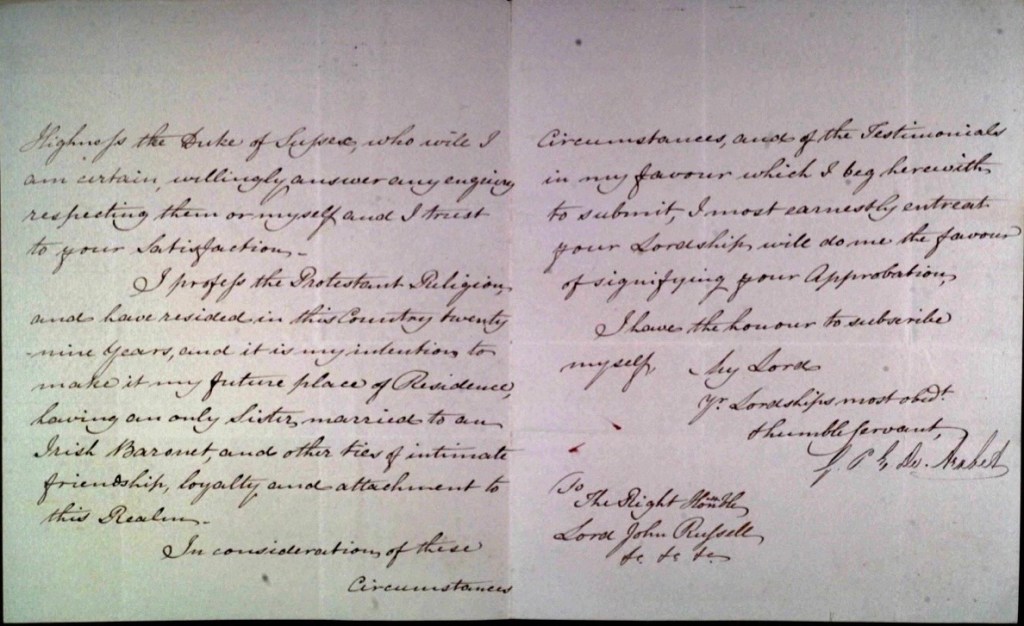
De Arabet’s petition, preserved today among the Home Office papers at The National Archives, gives us tantalising fragments of the life behind the application.
He described himself as:
“a native of Alicante in Spain, born of Protestant Parents and a family of the highest respectability…”
If his statement that he had lived in Britain for twenty-nine years was exact, he had arrived around 1806, while Britain and Napoleonic France were at war.
Why he came remains unclear.
But by 1835 his connections with Britain were considerable.
His only sister, he wrote, was married to an Irish baronet. He had formed “ties of intimate friendship, loyalty and attachment to this Realm.”
And then came the name that must have carried considerable weight.
His family, De Arabet claimed, was well known to Prince Augustus Frederick, Duke of Sussex.
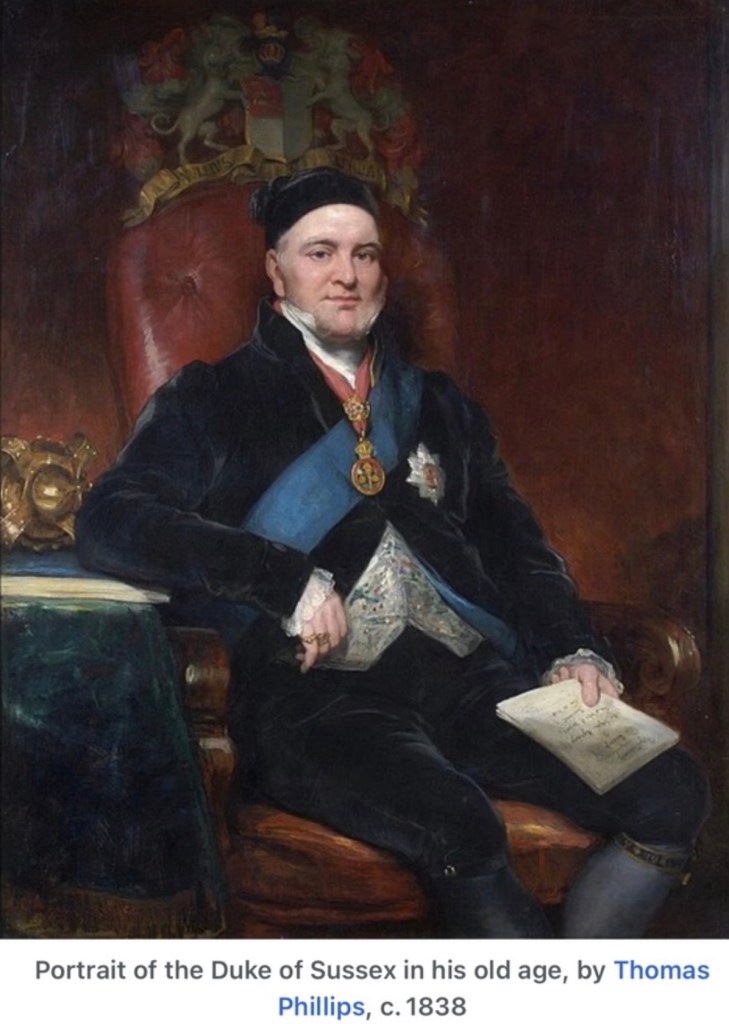
This was not simply an impressive acquaintance. The Duke was a son of George III, brother of King William IV and uncle of the future Queen Victoria.
De Arabet was effectively telling the authorities: if you wish to know who I am, ask a member of the Royal Family.
He also emphasised his Protestant faith.
Taken together, the letter feels almost like a carefully assembled portrait of belonging: long residence, family connections, religion, loyalty, respectability and powerful people prepared to vouch for him.
But there is another story hiding at the very top of his letter.
His address.
The Prince of Wales Hotel
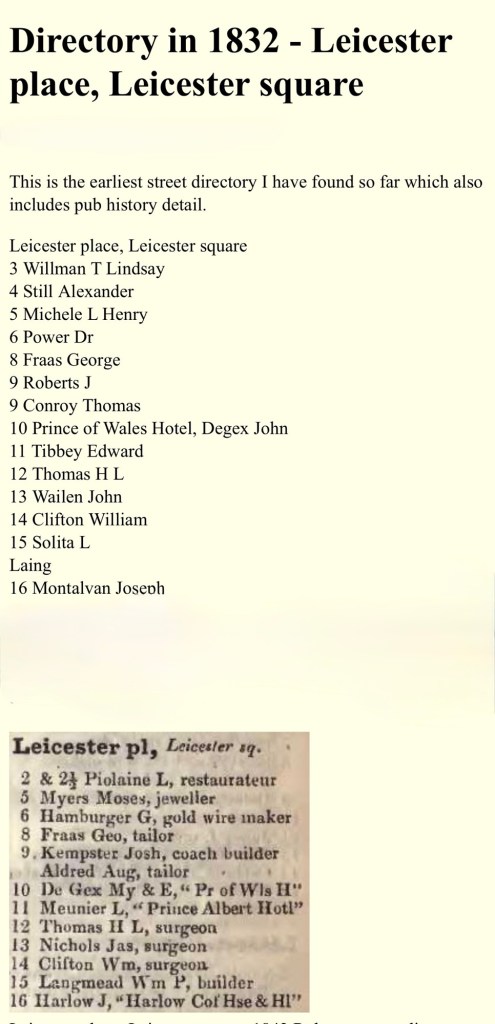
De Arabet wrote from the Prince of Wales Hotel, Leicester Place.
At first it looks like nothing more than an address.
Then the directories begin talking.
An 1805 directory records Curt & Degex operating the Prince of Wales Coffee House and Hotel. By 1811, John Degex appears in connection with the Prince of Wales Hotel.
The association continued.
In 1829 a directory lists:
“Degex John, Prince of Wales’s Hotel, Leicester place.”
In 1832 the establishment appears at 10 Leicester Place, and John De Gex remains associated with it in directories through the 1830s.
So when Baron de Arabet sat there writing his petition in June 1835, he was staying at an establishment which had already been associated with the De Gex family for around thirty years.
And the De Gex family had an immigrant story of their own.
John Francis De Gex
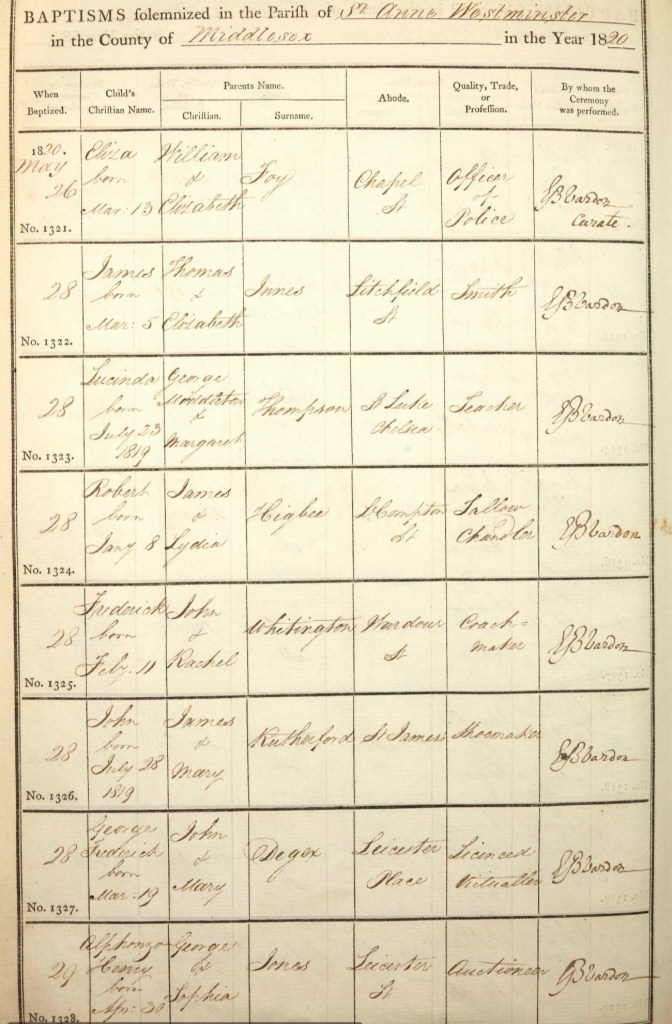
The hotelkeeper was John Francis De Gex, commonly known simply as John De Gex.
His family was of Swiss origin and had settled in England around the beginning of the nineteenth century.
A baptism register from St Anne, Westminster, provides a wonderful glimpse inside the household.
On 28 May 1820, George Frederick De Gex, born on 19 March, was baptised. His parents were recorded as John and Mary De Gex, their abode as Leicester Place, and John’s occupation as:
Licensed Victualler.
It ties the family firmly to both the street and the hospitality trade.
Another of their children would become considerably better known.
Their eldest son, Sir John Peter De Gex, born in 1809, became a barrister and distinguished law reporter. He entered Lincoln’s Inn in 1831 and was called to the bar in January 1835 — just months before Baron de Arabet wrote his letter from the family hotel.
John Francis De Gex made his will in December 1837. It identifies him with Leicester Place and names his wife Mary.
After his death, the De Gex connection with the hotel continued. By 1843, Mrs Mary Degex appears in a directory at the Prince of Wales Hotel.
By 1848, however, the proprietor listed there was Henry Bingham.
The De Gex era was coming to an end.
Two immigrant stories at one address
There is no evidence, at least so far, that Baron de Arabet chose the Prince of Wales Hotel because its proprietor was himself from an immigrant family.
Nor do we know whether De Arabet and John De Gex were friends.
It would be tempting to join those dots, but the surviving records do not allow us to.
What they do give us is something rather better.
For a brief moment in 1835, two stories intersected at 10 Leicester Place.
One belonged to a Spanish-born Protestant who had spent almost thirty years living in Britain and was now asking Parliament formally to make him British.
The other belonged to a Swiss immigrant family who had already established a business, raised children in London and become woven into British life.
One of those children would eventually be knighted.
The hotel itself has disappeared.
There appears to be no convenient photograph of the Prince of Wales Hotel waiting for us to discover it. Leicester Place and Leicester Square changed enormously as London developed, and the building that witnessed these events is gone.
But its absence doesn’t quite erase it.
A street directory gives us its number.
A baptism register gives us the family living there.
A will gives us the hotelkeeper’s full name.
And a letter written on 1 June 1835 places Baron de Arabet inside its story.
He ended that letter by asking Lord John Russell to signify his approval of the naturalisation application.
Nearly two centuries later, the address at the top of the page has allowed another story to emerge.
Not simply that of a Baron who wanted to become British.
But of the people and the vanished London hotel he encountered along the way.

