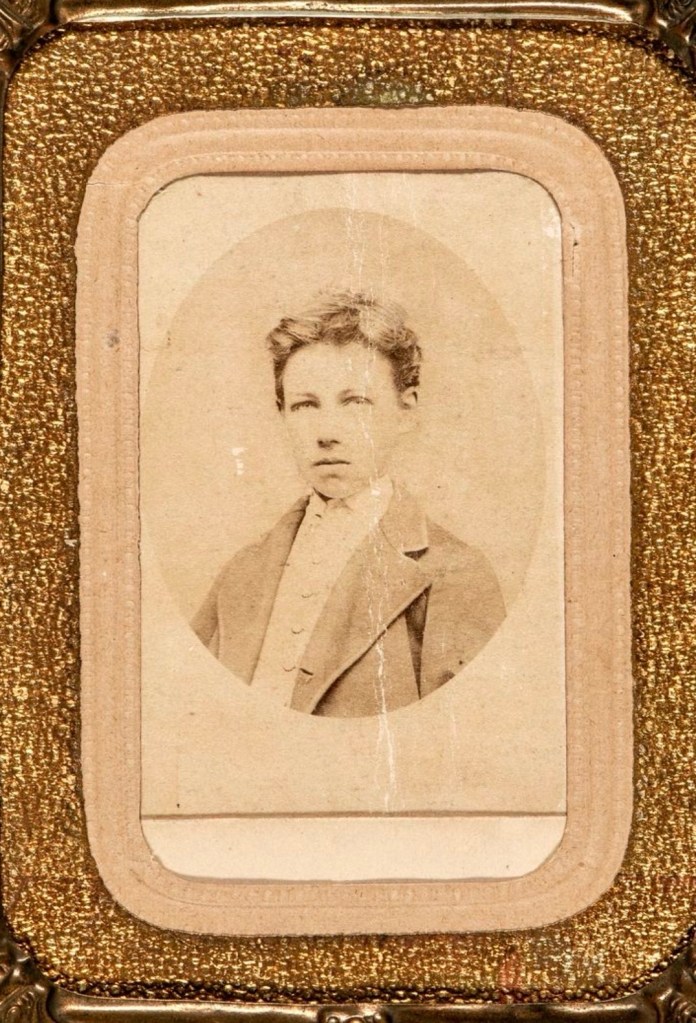
Arthur Rimbaud, 1866. Photograph attributed to Louis Eugène Vassogne. Public domain. Digital image via Wikimedia Commons / Catherine Gide collection.
Paul Verlaine, Arthur Rimbaud and a gunshot in Brussels
On 17 April 1873, the Paris police wanted information about a man named Paul Verlaine.
He was twenty-nine years old, had once worked at the Hôtel de Ville, had remained at his post during the Paris Commune, and had recently been moving between France, Belgium and England.
The instruction was bureaucratically simple. An officer was asked to establish Verlaine’s background, his behaviour during the insurrection, his circumstances and his morality.
It was three months before he shot Arthur Rimbaud.
The documents survive because the police were already interested in Verlaine before the gun was fired. They also provide an unusual way into one of literature’s most notorious relationships: not through poetry, memoir or romantic legend, but through reports, enquiries, gossip and administrative correspondence.
In 1944, Auguste Martin published a tiny privately printed booklet entitled Verlaine et Rimbaud: Documents inédits tirés des Archives de la Préfecture de Police. Only 150 copies were produced. Martin reproduced material he had found in the records of the Paris Prefecture of Police — documents in which two men now regarded as giants of French literature appear simply as people requiring investigation.
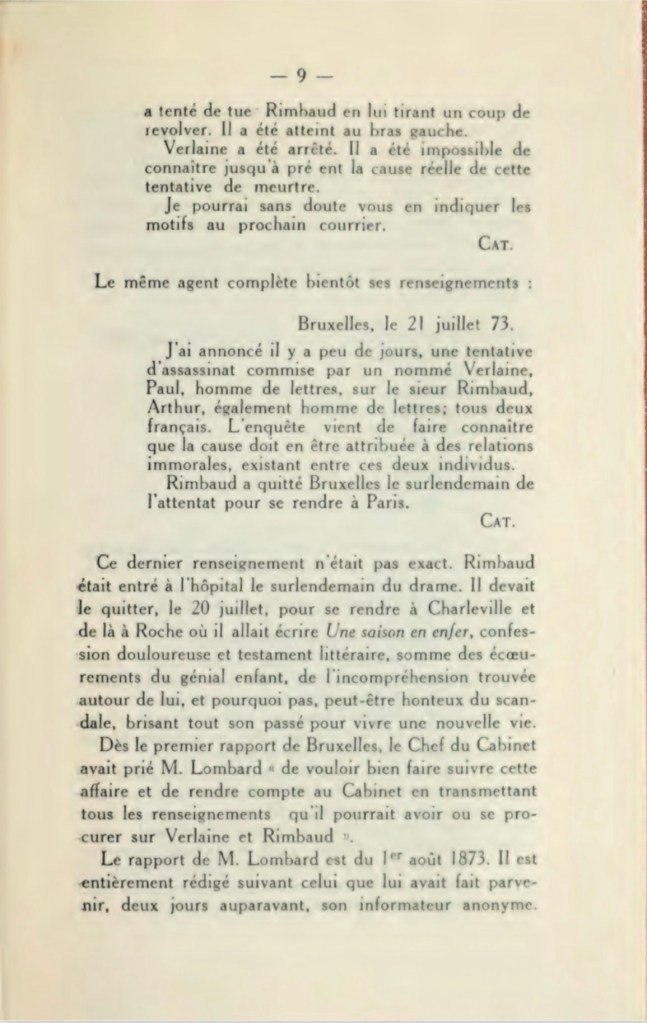
Auguste Martin, Verlaine et Rimbaud: Documents inédits tirés des Archives de la Préfecture de Police, 1944, p. 9. Copy no. 17 of an edition of 150. Digitised via Internet Archive.
Two poets under observation
By 1873 Paul Verlaine was already an established poet. Arthur Rimbaud was something altogether stranger: a prodigiously gifted teenager from Charleville who had arrived in Paris in 1871 after sending Verlaine some of his poetry.
Rimbaud was seventeen when their relationship began.
Verlaine was married to Mathilde Mauté and had a young son. His relationship with Rimbaud became both intimate and destructive, and the two men eventually left France together. By 1872 and 1873 they were spending considerable periods in London.
The police were watching from a distance.
One London report reproduced by Martin described Verlaine as a former employee of the Prefecture of the Seine and mentioned Rimbaud as a young man from Charleville who had left France during the Commune.
Another report concentrated rather more upon their relationship.
This is where the documents become both fascinating and dangerous.
The police material is full of the assumptions of its period. Officials and informants were interested not merely in what Verlaine and Rimbaud had done but in what sort of men they believed them to be. Their homosexuality, Verlaine’s political associations and his separation from his wife became part of the same investigation into character.
The archive therefore shouldn’t be read as an impartial account of their lives.
Martin himself warns us of this.
Introducing one police report, he admits that it contains errors of classification, names, dates and circumstances. The anonymous informant who supplied much of its information seems to have known a surprising amount about the couple — but also repeated rumour as fact.
That becomes spectacularly obvious later.
Brussels, July 1873
The relationship was collapsing.
Verlaine left London for Brussels on 3 July. Rimbaud followed and joined him there on 8 July. The following day they were staying at the Hôtel À la Ville de Courtrai, at 1 rue des Brasseurs, only a short distance from Brussels’ Grand-Place.
Verlaine’s mother was staying nearby, in an adjoining room.
On the morning of 10 July 1873, Verlaine bought a small revolver in the Galeries Saint-Hubert. Later that day, during yet another confrontation over Rimbaud’s determination to leave him, he fired at Rimbaud.
Rimbaud was struck in the left wrist. Contemporary and later accounts indicate that two shots were fired, although only one struck him.
The bureaucratic version of what had happened reached the files almost immediately.
A Brussels report of 11 July stated simply that Verlaine had:
attempted to kill Rimbaud by firing a revolver at him.
Rimbaud had been wounded in the left arm. Verlaine had been arrested.
The official writing is almost comically restrained considering the circumstances.
Ten days later another report supplied what its author believed to be an explanation. The investigation, he wrote, had established that the affair resulted from what he described as “relations immorales” existing between the two men.
That phrase is important.
It doesn’t tell us what Verlaine and Rimbaud thought about their relationship. It tells us what a nineteenth-century police officer thought about it.
And from that moment, the investigation was no longer simply about a gun.
“Love like tigers”
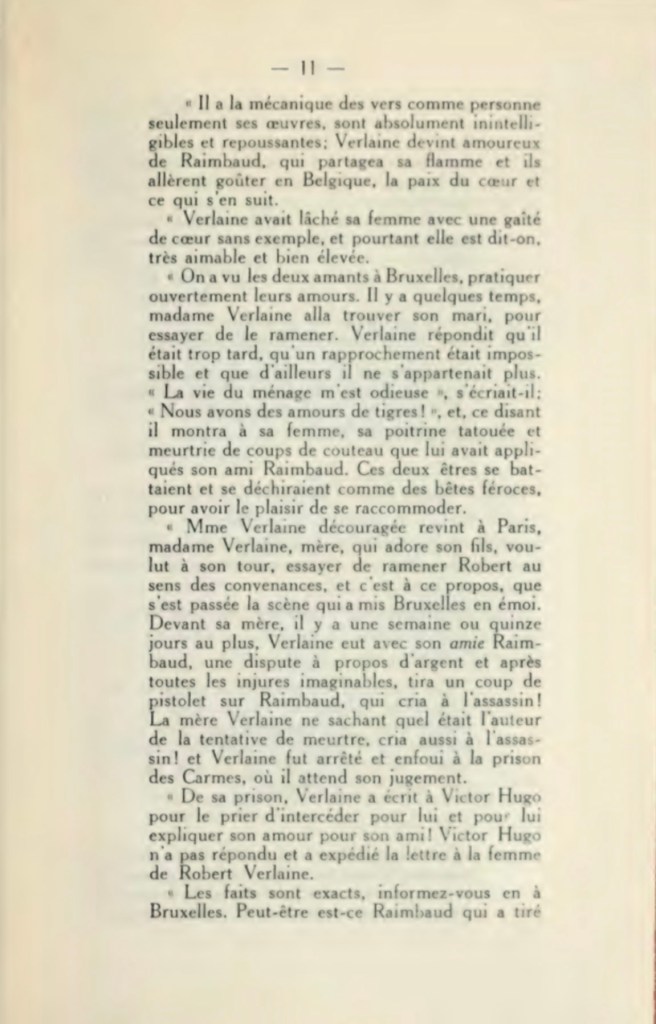
Auguste Martin, Verlaine et Rimbaud: Documents inédits tirés des Archives de la Préfecture de Police, 1944, p. 11. Copy no. 17 of an edition of 150. Digitised via Internet Archive.
The strangest document reproduced by Martin is a report dated 1 August 1873, prepared from information supplied by an anonymous source.
Its author describes Rimbaud as a gamin — a boy — brought into Parisian literary circles by Verlaine. He recounts the collapse of Verlaine’s marriage, the couple’s arguments and their life together in Belgium and England.
Then the report descends into melodrama.
According to the informant, Verlaine once described the relationship with the extraordinary expression:
“Nous avons des amours de tigres!”
“Ours is the love of tigers.”
There are stories of fights, injuries, reconciliation, drunkenness and rage. The informant confidently describes Verlaine firing the pistol and Rimbaud crying out that his companion was an assassin.
And then, at the end of the report, comes a magnificent collapse in confidence.
The informant admits that he hasn’t actually been able to establish who fired the revolver and wonders whether perhaps Rimbaud shot Verlaine instead.
He nevertheless assures the police that everything else is perfectly true.
It is a wonderful lesson in archival research.
A document can be contemporary.
It can be official.
It can contain genuine information unavailable anywhere else.
And it can still be wrong.
The investigation turns personal
There was considerably less uncertainty in the courts.
Verlaine was tried in Brussels on 8 August 1873. He was sentenced to two years’ imprisonment and fined 200 francs. The judgment was confirmed on appeal on 27 August. A Brussels police communication dated 30 August duly reported the result back to Paris. The later official correspondence reproduced by Martin confirms both the sentence and fine.
But the judicial investigation went far beyond determining who had fired the revolver.
A confidential communication from the Brussels prosecutor, written in 1882 and preserved in the police file, records that the examining magistrate had ordered Verlaine to undergo an intimate physical examination.
The doctors claimed to have found supposed signs of homosexual activity.
Such examinations were products of nineteenth-century forensic ideas about sexuality that are now discredited. Their inclusion in the file is nevertheless revealing. Verlaine was being judged not merely for an act of violence but through official scrutiny of his sexual life.
The archive therefore preserves two investigations running alongside one another.
One asked:
Did Paul Verlaine shoot Arthur Rimbaud?
The other asked:
What sort of man was Paul Verlaine?
For the police and judiciary of the period, the two questions became entangled.
Rimbaud leaves the file
Rimbaud’s part in the immediate story ended surprisingly quickly.
He was treated in hospital and subsequently returned towards Charleville and Roche. Soon afterwards Une saison en enfer — A Season in Hell — appeared in Brussels.
He was still only eighteen.
Within a few years, the extraordinary literary career for which Rimbaud would become famous was effectively over.
The police, however, remained interested in Verlaine.
The file reproduced by Martin continues long after the Brussels shooting. There are enquiries into Verlaine’s whereabouts, reports concerning his addresses, later incidents involving drink and disorder, and further observations about his associates.
In 1891, one report described a quarrel involving Verlaine, a journalist and a hotel manager.
In 1894 another police note recorded that the poet had arrived late for a literary banquet after drinking so many aperitifs that he had to be taken home.
The young man investigated because of the Commune and the scandal surrounding Rimbaud was ageing in the paperwork.
And then something curious happened.
From police subject to poet
Paul Verlaine died in January 1896.
Yet his police file did not end with his death.
Martin found later reports concerning commemorations held in 1898 and 1910.
The police were still observing gatherings connected with Verlaine — but the reason for their interest had changed.
The troublesome former municipal employee, political suspect, drunk, lover and convicted prisoner had become a celebrated poet.
Martin puts it beautifully: Verlaine had passed from the realm of police into the realm of celebrity.
There is something wonderfully strange about that transformation.
In April 1873 an official wanted to know Verlaine’s antecedents, morality and behaviour during the Commune.
In July another official reported that he had attempted to kill a young man named Arthur Rimbaud.
In August the courts sent him to prison.
Decades later, the authorities were recording people assembling to honour his memory.
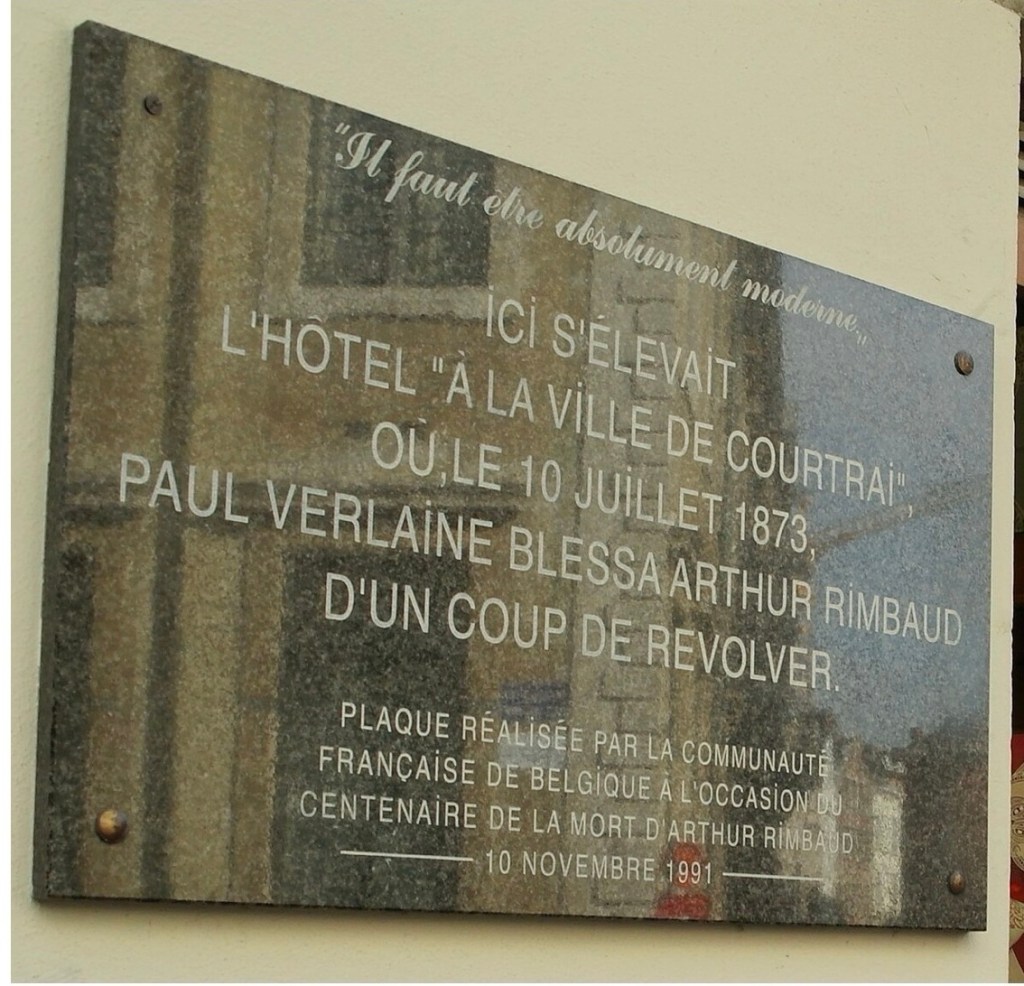
Memorial plaque, 1 rue des Brasseurs, Brussels. Installed in 1991 for the centenary of Arthur Rimbaud’s death. Photograph via Wikimedia Commons; credit the named photographer and licence shown on the individual file page.
Today the hotel itself has disappeared. It was demolished in 1979. But at 1 rue des Brasseurs, a plaque marks the place where it once stood. The plaque was installed on 10 November 1991, the centenary of Rimbaud’s death.
Across its top are words taken from Rimbaud:
“Il faut être absolument moderne.”
One must be absolutely modern.
Below them, history has been compressed into a single sentence:
Here stood the Hôtel À la Ville de Courtrai, where on 10 July 1873 Paul Verlaine wounded Arthur Rimbaud with a revolver shot.
A relationship, a bullet, a trial and decades of police paperwork reduced to a few lines of stone.
But open the file and the people return.
Not the mythic Rimbaud and Verlaine of literary history.
Two difficult young men moving between London, Paris and Brussels; watched, discussed and judged by officials who could never have guessed that their reports would one day become part of the story themselves.
And perhaps that is the strangest survival of all.
The police were attempting to record a scandal.
They accidentally helped preserve a piece of literary history.
 Life in the Margins