Marcel Raymond Paquier — No. 68387
A railwayman, a war, and the return to ordinary life.
Some records announce themselves dramatically.
Others begin with a number.
68387.
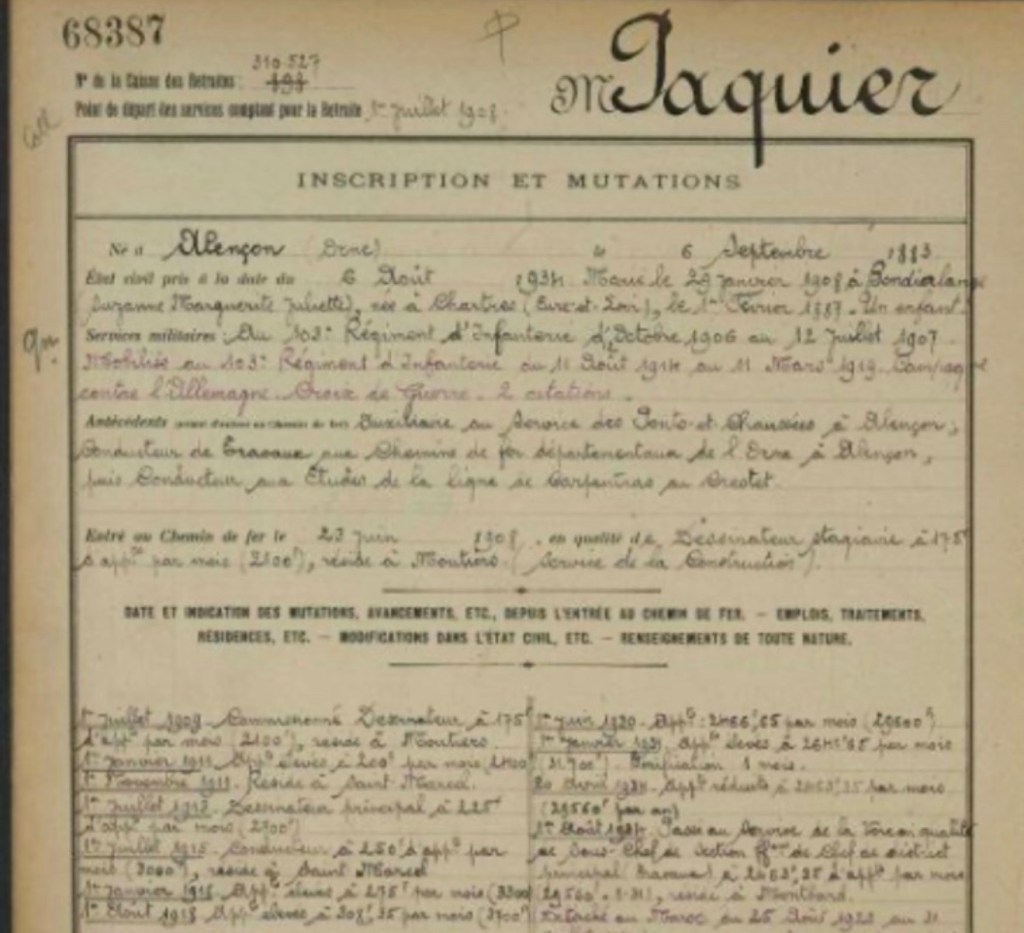
That was how Marcel Raymond Paquier first appeared: not as a soldier, not as a decorated veteran, and not even particularly as a person, but as an employee in a railway personnel file.
Gradually, however, the bureaucracy begins to give him back his life.
Marcel Raymond Paquier was born at Alençon, Orne, on 6 September 1883.
He had a technical background and, after completing military service in 1906–07, entered railway employment on 23 June 1907, apparently as a trainee technical draughtsman in the Construction Service.
What follows is the wonderfully methodical record of a railway career: appointments, promotions, transfers, salaries and allowances.
There are references to places including Saint-Nazaire and Rouen, and his salary steadily increased as his career developed.
On 1 January 1914, shortly before Europe changed completely, his annual salary was recorded at approximately 2,475 francs.
Then the railway record is interrupted by war.
The war
Marcel had already completed his military service before 1914, but in August 1914 he was mobilised again.
He served against Germany during the First World War, associated with the 103e Régiment d’Infanterie, and remained in military service for almost the entire conflict.
Among the brief administrative entries is one fact which suddenly lifts him from the paperwork:
Croix de Guerre — two citations.
Whatever Marcel experienced during those years, he had been recognised twice for his wartime service.
The railway file does not tell us the stories behind those citations.
Perhaps another archive does.
For the moment, the bare statement is enough.
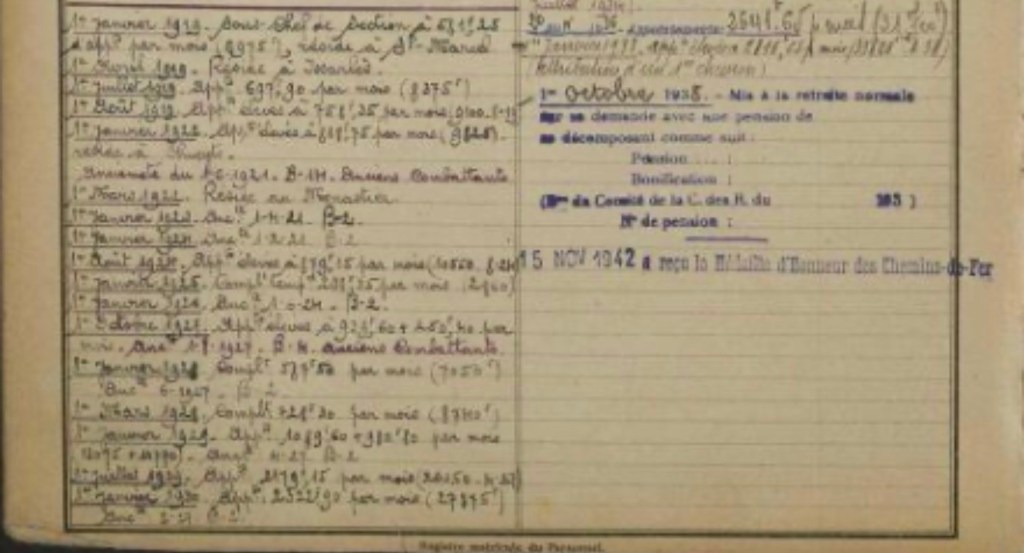
After the war, a note records his return to France in May 1919.
And then something striking happens.
His life becomes ordinary again.
Back to the railway
Marcel returned to railway employment and resumed the career which war had interrupted.
The following years are recorded through the language of administration: changes of grade, transfers, allowances and increasingly higher salaries.
It is not dramatic.
That is precisely why I like it.
A man went to war, survived it, was decorated twice, returned home — and then went back to work.
Year followed year.
Promotion followed promotion.
Salary followed salary.
The extraordinary slowly gave way to routine.
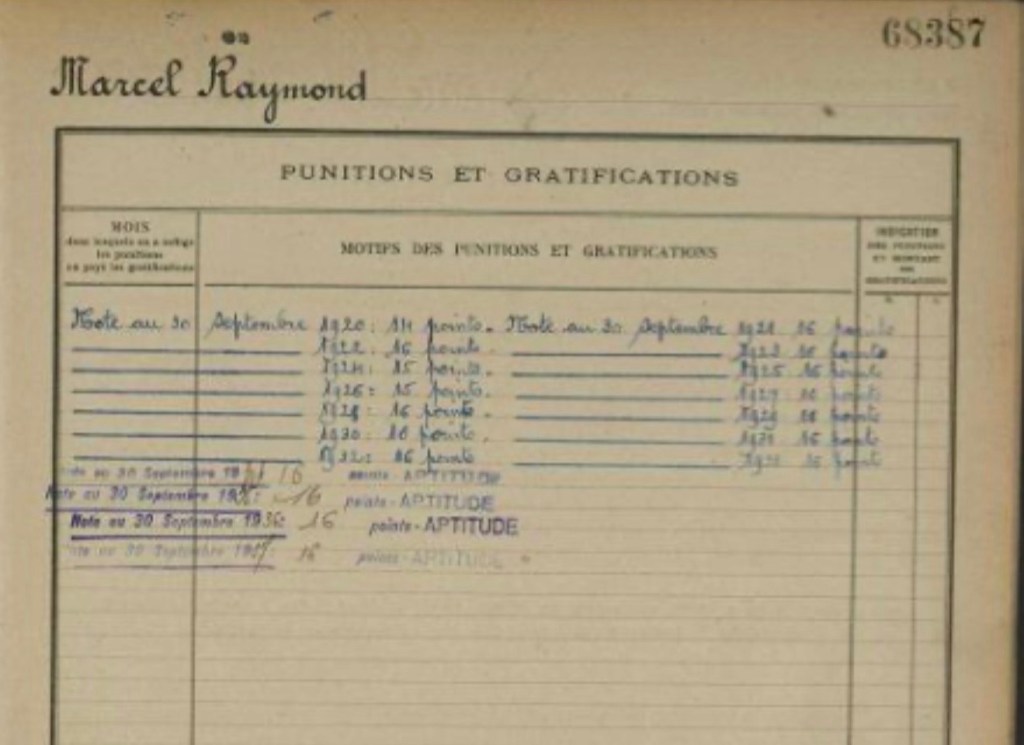
Punitions et gratifications
One of the most intriguing pages in the file carries the heading:
Punitions et gratifications
Literally, something like Punishments and rewards / commendations.
It sounds as though we are about to discover Marcel’s disciplinary history.
Instead, the page is almost reassuringly dull.
The surviving entries appear largely to be annual aptitude or merit assessments.
From 1920 through 1931, Marcel repeatedly receives a score of 16 points, with later entries continuing the same pattern of assessment.
Rather than revealing some scandalous collection of railway misdemeanours, the page suggests the opposite.
Marcel appears to have been regarded consistently as competent, reliable and suitable in his work.
There is something rather lovely about twelve years of bureaucratic consistency.
No dramatic rise.
No spectacular collapse.
Just:
16 points.
Again.
And again.
And again.
Retirement
Eventually the sequence of promotions, transfers and assessments comes to an end.
The final major entry reads:
1er octobre 1935 — Mis à la retraite normale
On 1 October 1935, Marcel Raymond Paquier retired under the normal retirement scheme.
Beneath it are the administrative calculations relating to his pension.
A later stamped annotation dated 15 November 1942 appears to concern that pension rather than a return to employment.
And with that, the railway file effectively closes.
Marcel had entered the railway in 1907.
Twenty-eight years later, he left it.
Between those two dates lay a world war.
No. 68387
What I like most about this record is its shape.
It begins with an apparently anonymous railway employee:
No. 68387.
Then, line by line, a person emerges.
A man born in Alençon.
Educated in technical work.
A railway draughtsman.
A soldier.
A veteran of the First World War.
A recipient of the Croix de Guerre with two citations.
And then, once again, a railwayman.
His war was extraordinary.
The rest of his life, at least as this file records it, was wonderfully ordinary.
And perhaps that is the point.
History naturally pulls us towards wars, disasters, medals and deaths.
But most lives are actually lived somewhere between those moments: going to work, earning a salary, being assessed, being promoted, coming home, and eventually retiring.
Marcel Raymond Paquier survived the extraordinary and returned to the ordinary.
And that is very much Life in the Margins.
 Life in the Margins